
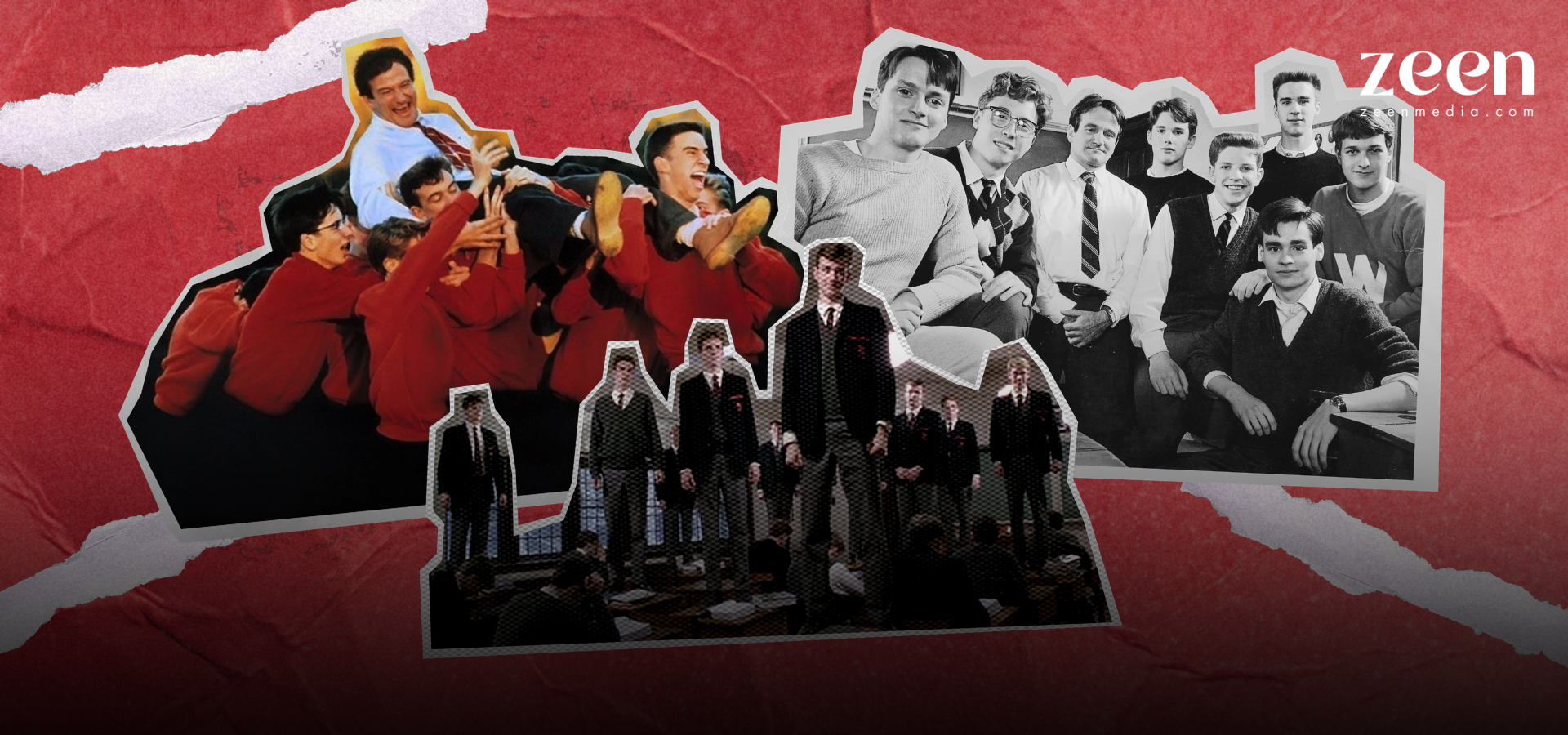
When Dead Poets Society premiered in 1989, it wasn’t just a coming-of-age drama—it was a cinematic manifesto about youth, authority, and the fragile courage it takes to speak in your own voice. Thirty-seven years later, its echoes still linger in classrooms, timelines, and the way we talk about ambition, pressure, and freedom.
But beyond nostalgia, the real question remains: what are we actually supposed to take away from it now?
1. “Carpe Diem” Was Never Just a Slogan
At first glance, John Keating’s famous line—“Carpe diem. Seize the day.”—sounds like motivational wallpaper. But the film reframes it as something heavier: not urgency, but awareness.

It is not about doing more. It is about refusing to live on autopilot.
As analyses of the film’s core theme consistently point out, Keating’s philosophy directly challenges institutional conformity, urging students to “make their lives extraordinary” instead of merely efficient or obedient
2. The Real Conflict Was Never Just School vs. Teacher
Welton Academy is often read as the villain: rigid, elitist, tradition-bound. But the film is more precise than that.
The deeper tension is between the fear of failure and fear of disappointing expectation
The institution enforces discipline, but the students enforce it on themselves long before Keating arrives. That’s what makes the tragedy sharper: even freedom requires unlearning.

Modern audiences now read Neil Perry’s arc not just as rebellion, but as a collision between personal desire and inherited pressure—a dynamic that still defines academic and professional life today.
Poetry as Protest, Even When It Looks Silly
One of the film’s quiet revolutions is how it treats poetry—not as academic ornament, but as emotional permission.
Keating dragging students into corridors, fields, and courtyards is not aesthetic flair. It’s a redefinition of where thinking is allowed to happen.
That idea still lands today in a world where productivity often replaces reflection and expression is filtered through “usefulness” The film insists after all, meaning does not need approval.
Neil Perry and the Cost of “Extraordinary”
If there is a fracture point in the film’s legacy, it is Neil Perry.
His story is often read as tragedy—but also as warning. Inspiration without protection becomes pressure. Passion without structure becomes exposure.
Modern readings increasingly frame the film’s emotional collapse not as failure of rebellion, but as failure of support systems around young ambition.
That shift matters. Because it complicates the myth of “just follow your dreams.”
The film asks something more difficult: What happens after you start listening to yourself?
Todd Anderson: The Quiet Revolution
If Neil represents intensity, Todd represents hesitation.
And that’s why his transformation remains one of the film’s most enduring emotional anchors. The moment he finally speaks—uncertain, trembling, but real—becomes the film’s clearest argument: You don’t need volume to be powerful. You just need arrival.
In today’s language, Todd is every student, worker, or young person learning to occupy space they were never taught to take.
“O Captain, My Captain”: When Mentorship Becomes Myth
Keating’s influence is often romanticized, but the film itself is more complex. He is not a savior. He is a catalyst, and catalysts don’t control outcomes.
That’s why the final classroom scene of students standing on desks in defiance still divides audiences. It’s not just gratitude. It’s an interpretation of liberation to some while others see consequence.
Thirty-seven years later, the film still refuses to tell you which reading is correct. Freedom in the film is not presented as a reward. It is presented as a responsibility. And responsibility, unlike rebellion, does not end with a standing-on-the-desk moment. It continues long after the credits roll.
What makes Dead Poets Society endure is not that it stayed relevant. It’s that every generation finds a different pressure point in it. In 1989, it was about authoritarian schooling. In the 2000s, it was about individualism. Today, it is about performance, pressure, and self-definition under constant visibility. The film leaves us with the thesis that “Seizing the day” is easy to quote. Living it is still the difficult part.