

Soft power is not always loud. Sometimes it shows up in quiet focus, steady footwork, and a young athlete who refuses to believe that sports are not for girls.
For Maggie Du Wong, that power plays out on the tennis court. The rising junior player from Cagayan de Oro has become one of the most promising young athletes in Philippine tennis, recently capturing two singles titles at the MJFC Digos City National Junior Tennis Championships in Davao del Sur. She ruled both the girls’ 14 and under and 16 and under divisions, marking her as the only double gold winner in the tournament.
But for Maggie, the significance of winning stretches beyond trophies.

“It feels good to represent all of the girls who are told they cannot play sports,” she tells ZEEN.

Maggie’s tennis journey began early. She started playing at five years old after her mother, Michelle Du Wong, decided to enroll them both in lessons following a medical check up that encouraged them to exercise together.
Since then, the young athlete has steadily risen through the ranks of the Philippine junior circuit. She previously held the No. 1 ranking in the girls’ 12 and under category under the Philippine Tennis Association and has competed in national and international tournaments, including events in the Asian Tennis Federation junior circuit.
Her training routine reflects the discipline behind that success. After school, Maggie trains for two hours daily and extends practice sessions to four hours on weekends in Cagayan de Oro.
Still, she does not frame tennis as something every young girl must pursue.
“If they want to play, they can try and see if they like it or not,” she says. “It’s not for everyone.”
That perspective reveals a quiet confidence. Maggie is not trying to prove that girls must dominate sports. Instead, she simply insists they should have the chance to try.
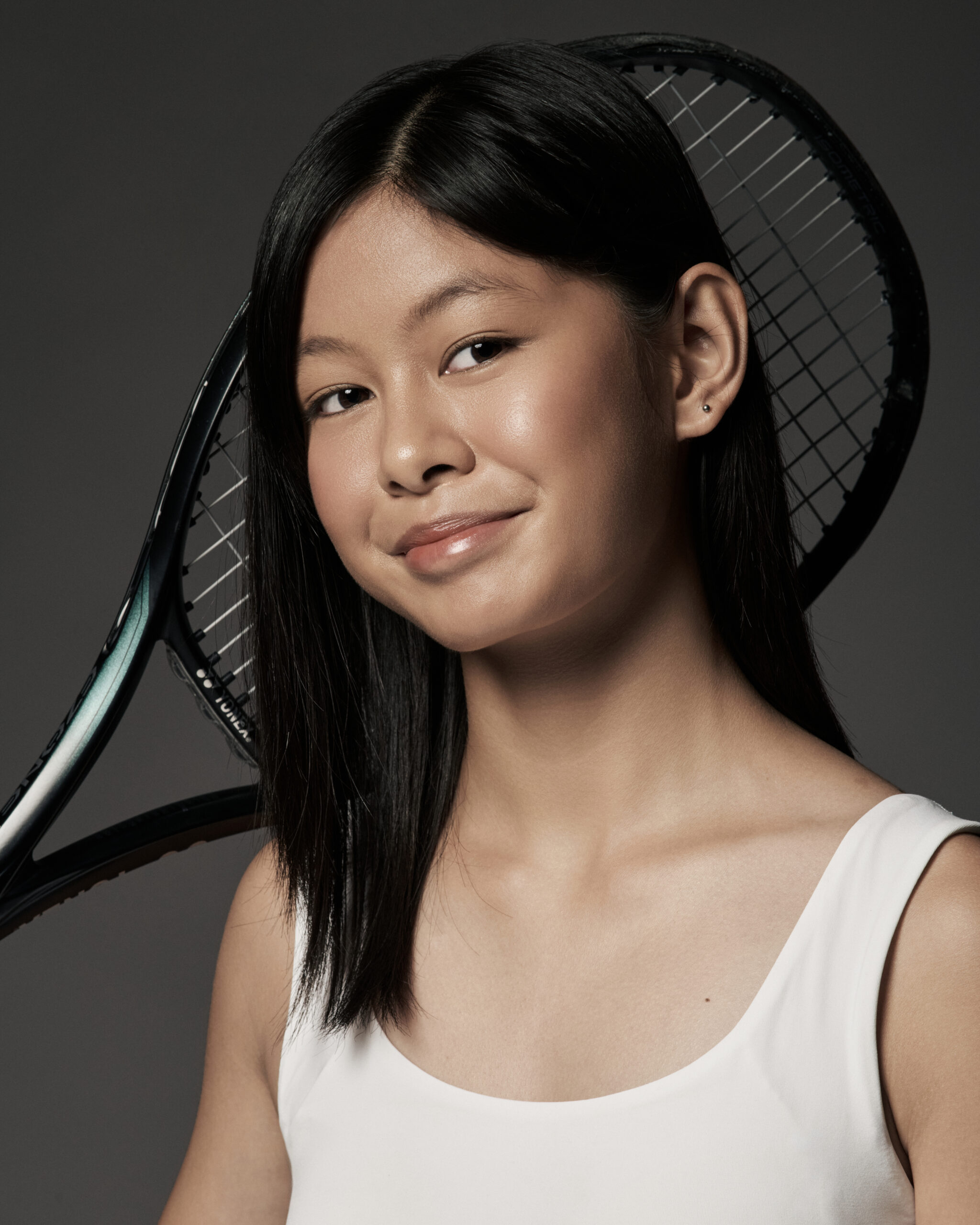
For young athletes, winning is often the most visible measure of success. But Maggie believes growth in sports comes from something else entirely.
“It is important because it may inspire them to push past their limits,” she says about the visibility of female athletes. “It is also important for all of us to know that we can’t learn without loss and our mistakes. Because how will we learn if there are zero mistakes?”
That mindset is one many professional athletes spend years developing. For Maggie, it is already part of how she sees competition.
Doubts, meanwhile, are inevitable. She encounters them often.
“Many people doubt my abilities and they also think I can’t handle things when it gets hard,” she says. “So I prove them wrong. But I don’t do it to impress them. I do it to improve and let myself see how much I can achieve.”
It is a philosophy that reflects a deeper kind of strength. The motivation does not come from critics. It comes from curiosity about her own limits.
Like many competitors, Maggie also carries small rituals into each match.
Her lucky charms change from tournament to tournament. Sometimes it is a necklace. Other times it is something she finds while traveling for competitions. Occasionally, the charm is less tangible.
“Sometimes my friends are my lucky charms,” she says.
These details show the balance between athlete and teenager. Amid the discipline of training and the pressure of tournaments, Maggie still brings pieces of her everyday life onto the court.
Redefining what strength looks like
This Women’s Month celebrates girls who are fearless and driven. For Maggie, that definition of strength is surprisingly simple.
“It means we can be who we want to be.”
That statement captures the essence of soft power in sports. It is not only about breaking records or winning championships. It is about shifting perceptions. When young girls see athletes like Maggie competing and succeeding, the idea of belonging in sports becomes more real.
In Philippine tennis, the path for Filipina athletes is steadily growing, with players like Alex Eala already making waves internationally. But the future of that movement also lies with younger players who are quietly rising through junior circuits across the country.
Maggie Du Wong may still be early in her journey. Yet every match she plays sends a simple message to girls watching from the sidelines.
They can step onto the court too.
Photography | Jerick Sanchez
Styled by | Jason Mago
Make Up | Helen Egan
Hair | Joemel Reyes
Movement Director | Arthur Osin
Creative director | Lorenz Namalatas
Sittings Editor | Maureen Manuel